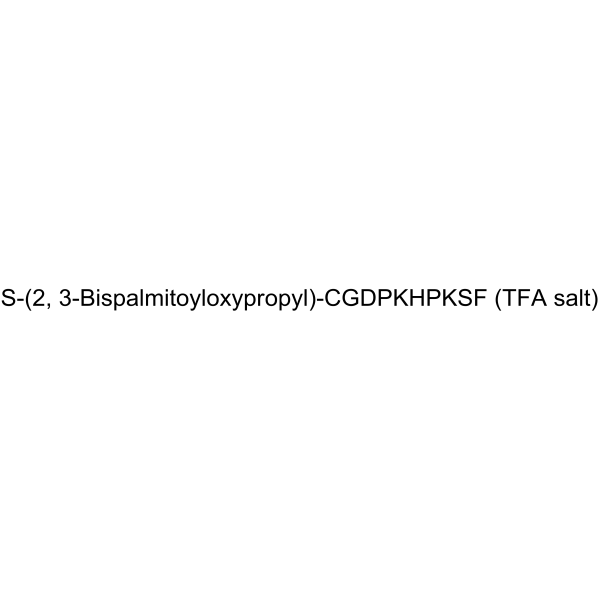
FSL-1 TFA
PRODUCTS SPECIFICATIONS

DESCRIPTION
Overview
| MDL | - |
|---|---|
| Molecular Weight | 1780.18 |
| Molecular Formula | C82H141F3N14O20S |
| SMILES | - |
2 Publications Citing Use of MCE
Summary
IC50 & Target
|
TLR2 |
TLR6 |
MMP-9 |
In Vitro
FSL-1 significantly reduces HSV-2 replication in human vaginal epithelial cells (EC)
[1]
.
FSL-1 induces significant resistance to experimental genital HSV-2 infection through elaboration of a specific cytokine response profile
[1]
.
FSL-1 (50 ng/mL, 24 hours) induces MMP-9 expression at both mRNA and protein levels in human monocytic THP-1 cells
[2]
.
FSL-1 activates the MAP kinase/NF-κB signaling pathway
[2]
.
MCE has not independently confirmed the accuracy of these methods. They are for reference only.
Cell Viability Assay [1]
| Cell Line: | V11I, V12I or V19I immortalized human vaginal EC |
| Concentration: | 6 μg or 0.1 μg |
| Incubation Time: | Added at 24, 6 or just prior to HSV-2 inoculation (10 4 pfu/well) |
| Result: | The 6 μg does produced significant reductions when delivered at 24 or 6 h prior to HSV-2 inoculation. The 0.1 μg dose produced reduced HSV-2 replication at 24 or 6 h prior to viral challenge. |
In Vivo
FSL-1 application significantly protectes against genital HSV-2 challenge in mice [1] .
MCE has not independently confirmed the accuracy of these methods. They are for reference only.
| Animal Model: | Female Swiss-Webster mice (weighing 20-25 g) [1] |
| Dosage: | 2 or 6 μg |
| Administration: | Delivered vaginally using a positive displacement pipet, prior to or following viral challenge as specified for each experiment. |
| Result: |
The 2 μg does delivered 6 h prior to HSV-2 challenge increased the ID50 (260 pfu) and LD50 (660 pfu) by 10-fold compared to DPBS vehicle control.
The single 6 μg dose produced significantly improved outcomes compared to DPBS vehicle application. |
Appearance
Solid
Shipping
Shipping with dry ice.
Storage
-80°C
Solvent & Solubility
H 2 O : 50 mg/mL ( 28.09 mM ; Need ultrasonic)
Stock Solutions
| Concentration Solvent Mass | 1 mg | 5 mg | 10 mg |
|---|
| 1 mM | 0.5617 mL | 2.8087 mL | 5.6174 mL |
| 5 mM | 0.1123 mL | 0.5617 mL | 1.1235 mL |
| 10 mM | 0.0562 mL | 0.2809 mL | 0.5617 mL |
References
- [1] William A Rose 2nd, et al. FSL-1, a bacterial-derived toll-like receptor 2/6 agonist, enhances resistance to experimental HSV-2 infection. Virol J. 2009 Nov 10;6:195.
- [2] Cathryn J Kurkjian,et al. The Toll-Like Receptor 2/6 Agonist, FSL-1 Lipopeptide, Therapeutically Mitigates Acute Radiation Syndrome. Sci Rep. 2017 Dec 11;7(1):17355.